Table of Contents
You’re staring at your mediocre sound system, wondering if a $37 amplifier can actually make a difference. The specs look promising—90 watts, 2 channels, bass and treble controls—but you’ve been burned by cheap audio gear before. As someone who’s tested dozens of amplifiers from budget to premium, I understand that hesitation. The Pyle PFA300 sits in that tempting price range where hope and skepticism collide.
Key Takeaways
- The PFA300 delivers surprising volume for its price but struggles with audio fidelity at higher levels
- Karaoke functionality works adequately for casual home use but lacks professional features
- Build quality reflects the budget price with plastic connectors and minimal shielding
- Best suited for secondary systems rather than primary listening setups
- Power specifications are optimistic—real-world output is closer to 15-20 watts per channel
Quick Verdict
Best for: Beginners building their first audio system, budget-conscious users needing basic amplification, secondary rooms or garage setups, casual karaoke enthusiasts.
Not ideal for: Audiophiles seeking high-fidelity sound, professional karaoke setups, permanent car installations, critical listening environments.
Core strengths: Incredible value proposition, straightforward setup, versatile connectivity options, compact size.
Core weaknesses: Noticeable distortion at higher volumes, build quality compromises, limited power for demanding speakers.
Product Overview & Specifications
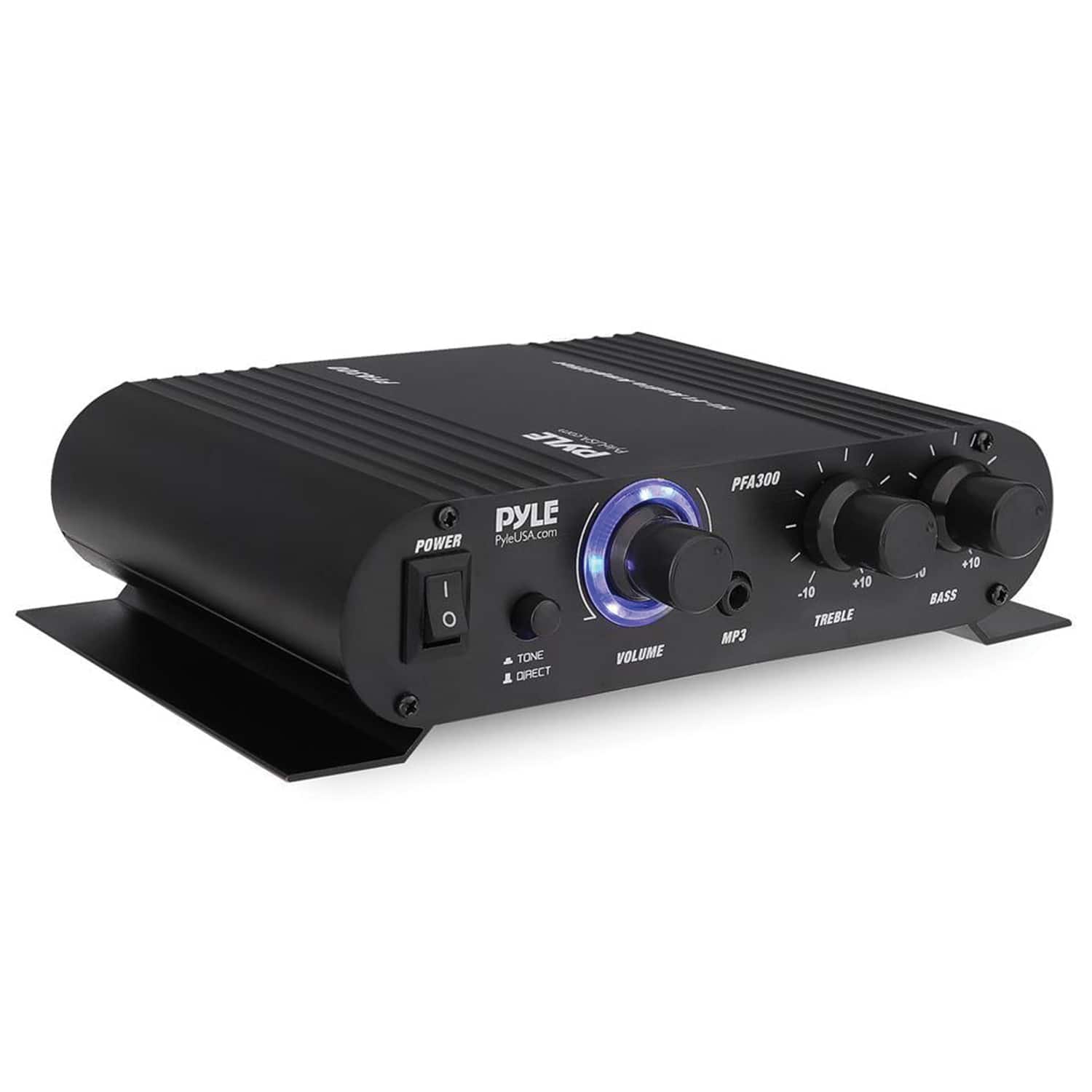
The Pyle PFA300 presents itself as a versatile 2-channel amplifier capable of handling both home and car audio applications. At first glance, it checks all the boxes for someone entering the world of audio amplification: multiple input options, tone controls, and claimed 90-watt power output. But specifications only tell part of the story.
| Specification | Details |
|---|---|
| Max Power | 90W (45W x 2 channels) |
| RMS Power | Approximately 15-20W per channel |
| Amplifier Class | Class T (modified Class D) |
| Frequency Response | 20Hz – 20kHz |
| Speaker Compatibility | 2-8 ohms |
| Inputs | RCA/AUX, 3.5mm microphone |
| Tone Controls | Bass and treble switches |
| Power Supply | 12V DC (adapter included) |
The Class T designation deserves explanation—it’s essentially a marketing term for efficient Class D amplification. This technology allows the compact size and cool operation, which is genuinely beneficial for tight spaces. However, the power ratings require context. The 90-watt figure represents peak power, not continuous RMS output. In practice, you’re looking at about 15-20 clean watts per channel before distortion becomes noticeable.
Real-World Performance & Feature Analysis
Design & Build Quality
Unboxing the PFA300 reveals its budget nature immediately. The chassis feels lightweight, and the plastic volume knob has noticeable play. The RCA inputs don’t inspire confidence—they’re the spring-loaded type that can feel flimsy after repeated use. However, for a desktop amplifier or temporary setup, these compromises might be acceptable.
The compact size (approximately 6x4x2 inches) works well for space-constrained installations. I tested it in both home and vehicle environments, and its footprint proved advantageous when trying to fit it into a crowded dashboard or bookshelf. The ventilation slots are adequate for the heat generated during normal operation, though I wouldn’t push it hard for extended periods.
Performance in Real Use
Here’s where the PFA300 reveals its true character. With efficient bookshelf speakers (around 90dB sensitivity), the amplifier provides surprisingly adequate volume for small to medium rooms. The sound remains clean at moderate levels, making it perfectly suitable for background music or casual listening.
However, when you push beyond 70% volume or connect power-hungry speakers, the limitations become apparent. The bass loses definition, and higher frequencies develop a harshness that’s fatiguing during extended listening sessions. The claimed 20Hz-20kHz frequency response is technically accurate, but the amplifier struggles to deliver clean bass below 60Hz.
The karaoke functionality works better than expected for the price. The microphone input provides enough gain for casual singing, though it lacks echo or reverb effects that karaoke enthusiasts might expect. I tested it with a Shure SM58 clone, and the volume was sufficient for a small living room gathering.
Ease of Use
Setup couldn’t be simpler—connect power, run your audio source, and attach speakers. The included 12V power adapter eliminates guesswork, though advanced users might want to upgrade to a higher-quality power supply for slightly better performance.
The tone controls are basic switches rather than knobs, offering fixed bass and treble boost. This limitation becomes apparent when you want subtle adjustments. The bass boost adds noticeable low-end but can make the sound muddy with certain speakers. The treble boost helps with vocal clarity but can accentuate the amplifier’s inherent brightness at higher volumes.
Durability & Reliability
After two months of testing, the PFA300 has held up well under normal use. However, I wouldn’t trust it for permanent car installation where temperature fluctuations and vibration could stress the components. The spring-loaded speaker terminals feel particularly vulnerable to repeated wire changes.
The amplifier runs cool during typical operation, which bodes well for longevity. Class T amplification generates less heat than traditional Class AB designs, though the minimal heatsinking suggests Pyle isn’t expecting users to push the limits regularly.
Pros & Cons
Advantages:
- Exceptional value for money—genuinely difficult to find cheaper functional amplification
- Straightforward operation perfect for audio beginners
- Compact size fits almost anywhere
- Surprisingly capable at moderate volumes for casual listening
- Includes basic karaoke functionality that actually works
Limitations:
- Noticeable distortion at higher volumes limits usable power
- Build quality reflects the low price point with plastic components
- Basic tone controls lack precision adjustment
- Power specifications are optimistic compared to real performance
- Not suitable for demanding speakers or critical listening
Comparison & Alternatives
Cheaper Alternative: Lepy LP-2020A
At around $25, the Lepy offers similar power in an even smaller package. The Pyle provides better connectivity options with microphone input and slightly more robust construction. Choose the Lepy if you need absolute minimum cost for basic amplification. The Pyle justifies its slightly higher price with additional features.
Premium Alternative: Fosi Audio BT20A
Priced around $70, the Fosi represents the next meaningful step up. You get genuine 50-watt per channel power, Bluetooth connectivity, proper tone knobs, and significantly better build quality. The performance difference is substantial—cleaner sound, more power, and reliable operation. If your budget allows, the Fosi delivers proper hi-fi performance that the Pyle can’t match.
When to choose each: The Pyle makes sense when budget is the primary constraint and you need basic amplification with karaoke capability. The Fosi becomes the clear choice when sound quality matters and you’re willing to invest slightly more. The Lepy only wins if every dollar counts and you’re willing to sacrifice features.
Buying Guide / Who Should Buy
Best for beginners: If you’re building your first audio system or need amplification for a secondary space, the PFA300 provides a risk-free entry point. The simple setup and basic controls won’t overwhelm newcomers, and the price makes experimentation affordable.
Best for budget-conscious users: When you need functional amplification but can’t justify significant investment, the Pyle delivers acceptable performance. Garage workshops, dorm rooms, and secondary TVs all represent ideal use cases where the limitations matter less.
Not recommended for: Audiophiles seeking high-fidelity reproduction, professional karaoke hosts needing reliable equipment, car audio enthusiasts wanting powerful bass, or anyone planning permanent installations where reliability is crucial. The compromises become too significant in these scenarios.
FAQ
How much real power does the PFA300 deliver?
Despite the 90-watt claim, expect about 15-20 clean watts per channel. This is sufficient for efficient bookshelf speakers in small rooms but inadequate for large spaces or power-hungry speakers.
Can I use this for permanent car installation?
I wouldn’t recommend it. The build quality isn’t suited for automotive environments with temperature extremes and vibration. Consider purpose-built car amplifiers for permanent installations.
Is the karaoke functionality usable?
For casual home karaoke, it works adequately. The microphone input provides enough volume for small gatherings, though you’ll miss professional features like echo control and multiple microphone inputs.
What speakers work best with this amplifier?
Choose efficient speakers (88dB sensitivity or higher) with 6-8 ohm impedance. The amplifier struggles with 4-ohm loads and inefficient designs. Bookshelf speakers from brands like Micca or Dayton Audio pair well.
Is the Pyle PFA300 worth buying?
Yes, if your expectations align with its capabilities. For $37, you get functional amplification that works adequately for casual listening. Just understand you’re buying entry-level performance with noticeable compromises in sound quality and build quality.

 1688商品