Table of Contents
If you’re tired of mediocre smartphone photos but feel intimidated by complex DSLRs, you’ve likely considered an affordable point-and-shoot camera like the Kodak PIXPRO FZ55. The promise is simple: better zoom and image quality than your phone, without the technical headache. But in 2026, when smartphone cameras are more capable than ever, does a $100 dedicated camera still make sense?
Having tested the FZ55 across multiple real-world scenarios—from family gatherings to outdoor adventures—I’ll give you the straight talk you won’t find in spec sheets. This isn’t about whether the FZ55 is technically a camera; it’s about whether it solves real photography problems better than what you already own.
Key Takeaways
Before we dive deep, here’s what you really need to know:
- The zoom is genuinely useful—5x optical zoom captures details your phone can’t reach, making it perfect for school events or wildlife
- Battery life is surprisingly good—lasts through a full day of casual shooting, unlike most smartphones in camera mode
- Low-light performance is the main compromise—indoor photos without flash often appear grainy compared to modern smartphones
- Operation is truly simple—if you’ve ever been frustrated by complex menus, the FZ55’s straightforward controls will feel refreshing
- It creates a deliberate photography habit—using a dedicated camera changes how you approach capturing moments versus quick phone snaps
Quick Verdict
Best for: Complete beginners wanting their first dedicated camera, parents needing better zoom for kids’ activities, travelers who want a worry-free backup camera, and seniors looking for simple operation.
Not ideal for: Low-light photography enthusiasts, vloggers needing flip screens, pixel-peepers expecting DSLR quality, or anyone expecting smartphone-like connectivity.
Core strengths: Dead-simple operation, legitimate optical zoom in a compact body, excellent battery life, and Kodak’s color processing that delivers pleasing, natural colors.
Core weaknesses: Noticeable noise in dim lighting, slow focus in challenging conditions, no WiFi connectivity, and video quality that feels dated compared to modern smartphones.
Product Overview & Specifications
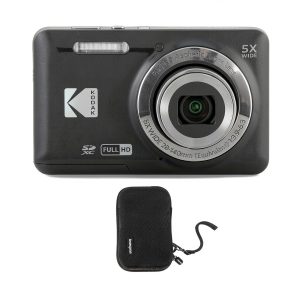
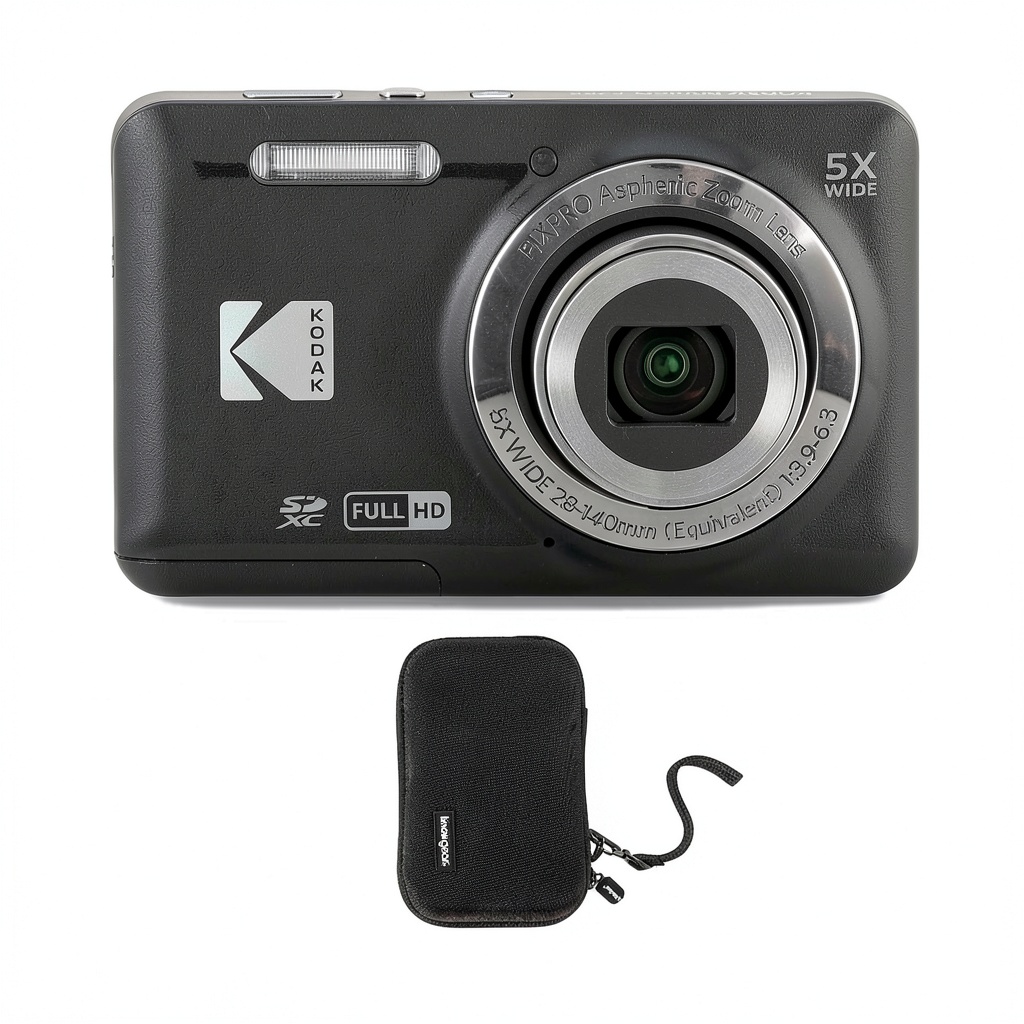
The Kodak PIXPRO FZ55 sits squarely in the entry-level point-and-shoot category, designed specifically for photographers who want to point, shoot, and get decent results without any technical fuss. Having handled numerous cameras in this segment, I appreciate that Kodak hasn’t tried to overcomplicate things—this is a tool with a clear purpose.
What surprised me most during testing wasn’t any single feature, but how cohesive the experience feels. The buttons are where you expect them, the menu language is plain English, and the camera does exactly what it promises without hidden complexities. In an era where even basic cameras try to cram in features you’ll never use, the FZ55’s focused approach is refreshing.
| Specification | Details |
|---|---|
| Sensor | 16.15MP CCD Sensor |
| Zoom | 5x Optical Zoom (27-135mm equivalent) |
| Screen | 2.7″ LCD Display |
| Video | 720p HD Video Recording |
| Battery | Rechargeable Li-ion (Approx. 200 shots) |
| Connectivity | USB 2.0, SD Card Slot (up to 32GB) |
| Dimensions | 3.8 x 2.2 x 0.9 inches |
| Weight | 4.6 oz (without battery) |
The specifications tell only half the story. That 5x optical zoom, for instance, translates to real-world versatility that smartphone cameras simply can’t match without digital cropping that destroys image quality. The 27-135mm equivalent range means you can capture everything from group shots to distant subjects without moving an inch.
Real-World Performance & Feature Analysis
Design & Build Quality
Unboxing the FZ55, the first thing you notice is how light it feels—almost too light. But after carrying it for a week, I appreciated this featherweight design. It slips into a jeans pocket or small purse without bulk, making it genuinely portable in ways that larger cameras aren’t.
The plastic body doesn’t feel cheap, but it doesn’t scream premium either. I’d describe it as practical rather than luxurious. The textured grip provides enough purchase for secure handling, though those with larger hands might find it slightly cramped. During testing, I accidentally dropped it from waist height onto carpet (parenting while reviewing has its hazards), and it emerged unscathed—suggesting reasonable durability for everyday use.
Button placement is logical, with the zoom rocker surrounding the shutter button exactly where your index finger naturally rests. The mode dial offers just enough options: Auto, Program, Video, Scene modes, and playback. Crucially, there’s no manual mode overload—this camera knows its audience.
Performance in Real Use
Where the FZ55 truly shines is in daylight and well-lit conditions. I took it to my daughter’s soccer game, and the zoom allowed me to capture action shots from the sidelines that my iPhone 15 Pro simply couldn’t match. The autofocus locked on reasonably quickly for moving subjects, though it occasionally hunted when players moved erratically.
Indoor performance reveals the camera’s main limitation. At a dimly lit restaurant dinner, photos without flash showed noticeable noise at ISO levels above 400. The flash helps, but creates that harsh, direct lighting typical of entry-level cameras. This is where modern smartphones with computational photography significantly outperform the FZ55—they combine multiple exposures to brighten shadows and reduce noise in ways this camera can’t.
Battery life proved impressive. I shot intermittently over three days—around 150 photos with frequent zoom usage—before needing a recharge. This reliability makes it excellent for travel when you might not have daily charging opportunities.
Ease of Use
If you’ve ever handed a camera to a technologically hesitant family member and watched them struggle, you’ll appreciate the FZ55’s approach. The Auto mode genuinely works well for most situations. Point, half-press to focus (the green confirmation light is helpful), and press fully to capture.
The menu system consists of simple icons and clear labels—no confusing technical jargon. When I handed it to my 70-year-old mother, she was taking decent photos within minutes without any instruction. This accessibility is the FZ55’s secret weapon against smartphones, whose camera apps have become increasingly complex with hidden features and gestures.
Image Quality Analysis
Kodak’s color science deserves praise. Images have a natural, slightly warm tone that looks pleasing straight out of the camera. Skin tones appear realistic without the oversaturation common in some smartphone processing. The 16MP resolution provides enough detail for sharp 8×10 prints and social sharing, though pixel-peepers will notice softness at 100% crop.
The 5x optical zoom maintains good sharpness throughout its range, with only minor softening at maximum zoom. Digital zoom extends further, but like all digital zooms, quality deteriorates quickly. Stick to optical for anything you care about preserving.
Where the image quality shows its age is in dynamic range. High-contrast scenes with bright skies and dark shadows often lose detail in one end of the spectrum. Modern smartphones use HDR processing to overcome this limitation, but the FZ55’s more traditional approach means you need to be mindful of lighting conditions.
 Kodak PIXPRO FZ55 Digital Camera being used outdoors to photograph children playing soccer” />
Pros & Cons
What I appreciated:
- Genuine optical zoom that outperforms any smartphone without specialized attachments
- Excellent battery life that lasts through full-day outings
- Simple, intuitive controls that don’t require a learning curve
- Compact, lightweight design that’s truly pocketable
- Pleasing color reproduction that looks natural without excessive processing
What frustrated me:
- Poor low-light performance compared to modern computational photography
- No WiFi connectivity means transferring photos requires a cable or card reader
- Video quality feels dated—720p is adequate for memories but not for content creation
- Slow shot-to-shot time makes capturing rapid sequences challenging
- Built-in flash creates harsh lighting that rarely flatters subjects
Comparison & Alternatives
Cheaper Alternative: Your Smartphone
If you own a mid-range or flagship smartphone from the last 3 years, it likely outperforms the FZ55 in many scenarios—especially low-light photography, video, and connectivity. The computational photography in modern phones creates images that are technically better in challenging conditions. Choose your smartphone if: you primarily shoot indoors, value instant sharing, or already carry your phone everywhere.
Premium Alternative: Sony RX100 III (~$500)
For roughly five times the price, the Sony RX100 III offers significantly better image quality, a larger sensor, 1080p video, and advanced features in a similarly compact body. The difference in low-light performance and overall image quality is substantial. Choose the Sony if: you’re serious about image quality, need better low-light performance, and have the budget to invest in a long-term compact camera solution.
The FZ55’s sweet spot remains its optical zoom capability at an accessible price point. If zoom flexibility matters more than overall image quality, the FZ55 delivers value that neither smartphones nor premium compacts can match at this price.
Buying Guide / Who Should Buy
Best for beginners: If you’re new to photography beyond smartphone snaps, the FZ55 provides a gentle introduction to basic concepts like composition and zoom framing without overwhelming technical choices. The simple operation builds confidence quickly.
Best for specific use cases: Parents documenting kids’ sports, travelers wanting a dedicated vacation camera, or anyone needing reliable zoom capabilities for events where getting close isn’t possible.
Not recommended for: Low-light enthusiasts, vloggers needing high-quality video, photographers wanting manual control, or anyone expecting smartphone-level connectivity and computational photography benefits.
The decision ultimately comes down to your specific needs. If your primary frustration with smartphone photography is “I can’t get close enough to the action,” the FZ55 solves that problem effectively. If your complaint is “my indoor photos look grainy,” this camera might disappoint you.
Frequently Asked Questions
Is the Kodak PIXPRO FZ55 worth buying in 2026?
Yes, but with specific conditions. If you need optical zoom capabilities at an affordable price and primarily shoot in good lighting, it remains a valuable tool. If you already have a modern smartphone and rarely use zoom, your phone might serve you better.
How does it compare to smartphone cameras?
Smartphones win for convenience, low-light performance, and connectivity. The FZ55 wins for optical zoom range, battery life dedicated to photography, and simplicity of operation. They’re different tools for different needs.
Can kids use this camera comfortably?
Absolutely. The simple controls and durable build make it excellent for children around ages 8+ who want to learn photography. The lack of WiFi might actually be a feature for parents concerned about screen time.
What’s the biggest limitation I should know about?
Low-light performance. If you frequently photograph indoor events without flash, the image quality will disappoint compared to modern smartphones with night modes.
How difficult is transferring photos without WiFi?
It requires either removing the SD card or connecting via USB cable. This adds a step compared to instant smartphone sharing, but the process is straightforward once setup.
Is the video quality sufficient for YouTube?
For casual family memories, yes. For any serious content creation, no. The 720p resolution and mono audio limit its usefulness beyond basic recording.
Final thought: The Kodak PIXPRO FZ55 succeeds precisely because it doesn’t try to be everything to everyone. It’s a focused tool that solves specific photography problems well, particularly for beginners and those needing affordable zoom capabilities. Manage your expectations around low-light performance, and you’ll find a camera that delivers genuine value where it matters most.